Are you searching for the Lala Ramswaroop Calendar 2026? When it comes to authentic, time-tested Hindu Panchangs in North India, one name comes up before any other: the Lala Ramswaroop Ramnarayan Sons Panchang. This isn’t just a calendar hanging on a wall — for millions of Indian families, it’s the reference point for everything from daily puja timing to fixing the date of a wedding.
This detailed guide takes you through the Lala Ramswaroop Calendar 2026 from January to December — every major festival, Ekadashi, Purnima, Amavasya, and Vivah Muhurat, verified against standard Panchang calculations so you can plan the year with confidence. Bookmark this page; you’ll likely come back to it more than once this year.
What Is the Lala Ramswaroop Calendar?
The Lala Ramswaroop Calendar is one of North India’s oldest and most trusted Hindu lunisolar Panchangs, first published roughly nine decades ago under the editorship of Shri Prahlad Agarwal. What began as a single publisher’s effort has, over the decades, grown into a household name that connects crores of people to their religion and culture every single year.
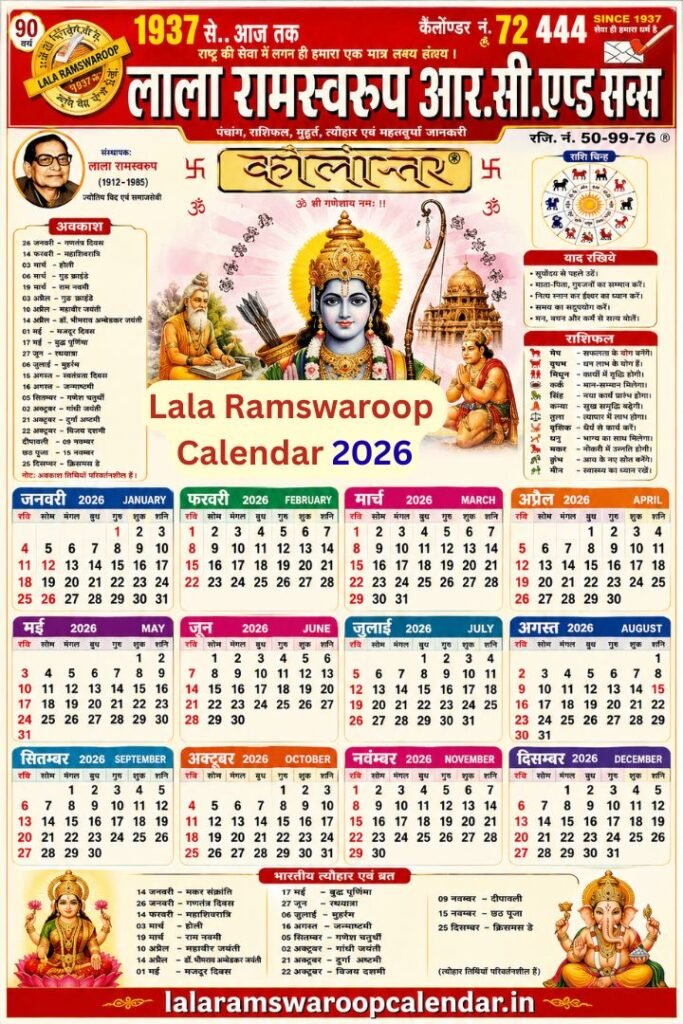
Lala Ramswaroop Calendar 2026 PDF Free Download
A quick and important note before we go further: the original printed Lala Ramswaroop Ramnarayan Panchang is a copyrighted publication, sold as a physical printed edition in the market. Distributing a scanned copy of the actual calendar as a free PDF online would go against copyright rules, so that isn’t something offered here.
What this page offers instead is a complete, independently compiled month-wise reference for the whole of 2026 — every major festival, Vrat, and Muhurat date, based on standard Vedic Panchang calculations. You’re welcome to bookmark this page, or use your browser’s Print > Save as PDF option to keep an offline copy for your own reference. It works as a genuinely useful digital companion, even without the scanned original.
Below is our month-wise reference for 2026, with a downloadable summary available for each month:
| Month | Reference |
|---|---|
| Lala Ramswaroop Calendar January 2026 | Download |
| Lala Ramswaroop Calendar February 2026 | Download |
| Lala Ramswaroop Calendar March 2026 | Download |
| Lala Ramswaroop Calendar April 2026 | Download |
| Lala Ramswaroop Calendar May 2026 | Download |
| Lala Ramswaroop Calendar June 2026 | Download |
| Lala Ramswaroop Calendar July 2026 | Download |
| Lala Ramswaroop Calendar August 2026 | Download |
| Lala Ramswaroop Calendar September 2026 | Download |
| Lala Ramswaroop Calendar October 2026 | Download |
| Lala Ramswaroop Calendar November 2026 | Download |
| Lala Ramswaroop Calendar December 2026 | Download |
Note: For the official, 100% original printed edition — complete with daily planetary transit values — we’d strongly recommend purchasing the authentic copy from your local stationery shop, a newspaper vendor, or a verified online retailer such as Amazon or Flipkart. What you’ll find in each month-wise reference above is our own compiled summary of festival, Vrat, and Muhurat dates, not a reproduction of the copyrighted original.
Lala Ramswaroop Calendar 2026: Month-by-Month Breakdown
1. January 2026 (Paush – Magha)
January opens the English calendar year with the sun in Uttarayana — considered highly auspicious in Sanatan tradition — alongside the peak of North Indian winter. Makar Sankranti is the standout festival of the month, and it’s also the point from which day length starts noticeably increasing again.
- New Year’s Day: January 1, 2026 (Thursday)
- Lohri: January 13, 2026 (Tuesday) — celebrated with particular enthusiasm in Punjab and North India, with bonfires and folk songs marking the harvest
- Makar Sankranti / Pongal: January 14, 2026 (Wednesday) — the sun’s entry into Capricorn; donations and holy baths hold special significance on this day
- Vasant Panchami: January 23, 2026 (Friday) — Goddess Saraswati’s festival, considered ideal for beginning a child’s education
- Republic Day: January 26, 2026 (Monday) — national holiday
2. February 2026 (Magha – Phalguna)
February signals the arrival of spring, with new blooms appearing across North India, and this year it also carries Maha Shivaratri, one of the year’s biggest Shaivite observances.
- Maha Shivaratri: February 15, 2026 (Sunday) — the day of Shiva and Parvati’s celestial wedding, marked with an all-night vigil and Rudrabhishek at Shiva temples across the country, with especially heavy crowds at major Jyotirlingas
3. March 2026 (Phalguna – Chaitra)
March is the month of colour and camaraderie, closing out Phalguna, the last month of the Hindu year, and opening straight into Chaitra Navratri and the new Vikram Samvat.
- Holika Dahan: March 3, 2026 (Tuesday) — bonfires symbolising the triumph of good over evil
- Holi / Dhulandi: March 4, 2026 (Wednesday) — the festival of colours, celebrated with great warmth across the country
- Chaitra Navratri Begins / Gudi Padwa / Ugadi: March 19, 2026 (Thursday) — Ghatasthapana, the Hindu new year (Vikram Samvat), and Maharashtra’s Gudi Padwa all fall on this same auspicious day
- Ram Navami: March 27, 2026 (Friday) — the ninth and final day of Chaitra Navratri, marking Lord Rama’s birth
4. April 2026 (Chaitra – Vaishakh)
April brings the start of summer heat, and this is the month farmers across North India bring in the Rabi harvest. It’s significant from both a religious and cultural standpoint.
- Hanuman Jayanti: April 2, 2026 (Thursday) — falls on Chaitra Purnima, celebrated with Hanuman Chalisa recitations from early morning
- Baisakhi: April 14, 2026 — a major Sikh harvest festival, also marking the solar new year across Punjab
- Ambedkar Jayanti: April 14, 2026 — Dr. B.R. Ambedkar’s birth anniversary, observed as a national holiday
- Akshaya Tritiya / Parashurama Jayanti: April 19–20, 2026 — one of the Saade Teen Muhurat, meaning no separate Muhurat calculation is needed for weddings, gold purchases, or launching a new venture on this day
5. May 2026 (Vaishakh – Jyeshtha)
May carries the heat of early summer across most of the country, and the month’s main religious observance is Buddha Purnima.
- Buddha Purnima: early May 2026 — Lord Buddha’s birth anniversary, falling on Vaishakh Purnima, observed with prayers and visits to Buddhist viharas
6. June 2026 (Jyeshtha – Ashadha)
June brings peak Jyeshtha heat across North India, and with it, the single toughest fast of the entire Hindu year.
- Nirjala Ekadashi: June 25, 2026 (Thursday) — observed without food or even water for the entire day, considered the most demanding of all 24 Ekadashis in the year
- Vat Savitri Vrat: married women worship the banyan tree, praying for their husband’s long life and the family’s prosperity
- Ganga Dussehra: commemorates the Ganga’s descent to earth; a holy bath in the river holds special merit on this day
7. July 2026 (Ashadha – Shravan)
July brings the gentle blessing of Guru Purnima and the official start of Sawan, the month most devoted to Lord Shiva across the country.
- Guru Purnima: July 29, 2026 (Wednesday) — a day to seek blessings from teachers and gurus, and to offer worship to Ved Vyas
- Sawan Begins: the month sacred to Shiva; millions of Kanwariyas carry Ganga water on foot to offer at Shiva temples, and each Sawan Monday is observed as a special fasting day
- Devshayani Ekadashi: July 25, 2026 (Saturday) — Lord Vishnu enters four months of cosmic sleep from this date, and Chaturmas begins
8. August 2026 (Shravan – Bhadrapada)
August opens a long stretch of major festivals in India that continues right through to December, with barely a quiet week in between.
- Independence Day: August 15, 2026 (Saturday) — India’s national holiday
- Raksha Bandhan: August 28, 2026 (Friday) — sisters tie a Rakhi on their brothers’ wrists, symbolising protection and lifelong bond
9. September 2026 (Bhadrapada – Ashwin)
September continues the festive spirit of the previous month, welcoming Lord Ganesha into homes before the calendar turns more reflective with Pitru Paksha.
- Krishna Janmashtami: September 4, 2026 (Friday) — celebrated at the stroke of midnight, with Mathura and Vrindavan seeing the grandest festivities anywhere in the country
- Ganesh Chaturthi: September 14, 2026 (Monday) — the start of ten days of Ganeshotsav, with the Madhyahna Sthapana Muhurat falling roughly between 11:00 AM and 1:30 PM depending on your city
- Anant Chaturdashi / Ganesh Visarjan: September 25, 2026 (Friday) — the final and biggest day of immersion for households and public Mandals that keep the idol the full ten days
- Pitru Paksha / Shradh Begins: September 27, 2026 — a 15-day period when no new or auspicious activity (like buying a vehicle or new clothes) is undertaken, reserved instead for Tarpan and remembering one’s ancestors
10. October 2026 (Ashwin – Kartik)
If any single month deserves to be called Hinduism’s biggest and brightest, it’s October — the devotion of Navratri, the triumph of truth over evil, all converge here within a few short weeks.
- Sharad Navratri Begins: October 11, 2026 (Sunday) — Garba and Dandiya are organised across the country through the nine nights of worship to Goddess Durga
- Durgashtami / Maha Navami: October 18–19, 2026 — Kanya Pujan is performed on these days, honouring young girls as forms of the goddess
- Dussehra / Vijayadashami: October 20, 2026 (Tuesday) — marking Lord Rama’s victory over Ravana, observed with Shastra Puja and the burning of Ravana effigies
- Karva Chauth: October 29, 2026 (Thursday) — married women observe a Nirjala fast for their husband’s long life, breaking it only after sighting the moon in the evening
11. November 2026 (Kartik – Margashirsha)
November belongs to Diwali and Chhath Puja, two of the year’s most widely observed and emotionally significant festivals for North Indian households.
- Dhanteras: November 6, 2026 (Friday) — buying gold, silver, or new utensils is considered highly auspicious
- Diwali / Deepavali: November 8, 2026 (Sunday) — the year’s biggest festival; the Lakshmi-Ganesh Puja is timed to the Sthir Lagna Muhurat for maximum benefit
- Bhai Dooj: November 10, 2026 (Tuesday) — two days after Diwali, when brothers visit their sisters’ homes for a festive meal
- Chhath Puja: November 13–16, 2026 — Nahay Khay (13th), Kharna (14th), Sandhya Arghya to the setting sun (15th), and Usha Arghya to the rising sun (16th), observed with particular devotion in Bihar, Jharkhand, and Eastern UP
- Devutthana Ekadashi / Tulsi Vivah: November 20, 2026 (Friday) — Lord Vishnu is believed to wake from his four-month sleep, and with it, Chaturmas ends and wedding season resumes almost immediately
12. December 2026 (Margashirsha – Paush)
December closes the year with biting North Indian cold and, for many families, wedding season in full swing right up to the Kharmas break.
- Vivah Panchami: commemorates the wedding of Lord Rama and Sita, considered auspicious despite falling outside the main wedding season
- Gita Jayanti / Mokshada Ekadashi: December 14, 2026 (Monday) — the day Lord Krishna is believed to have given Arjuna the wisdom of the Bhagavad Gita on the battlefield of Kurukshetra
- Christmas: December 25, 2026 (Friday) — widely celebrated across India’s Christian community and increasingly as a cultural occasion more broadly
Important Vrats: Ekadashi, Purnima, Amavasya and Pradosh
The Lala Ramswaroop Panchang is used most often, month after month, to work out the correct Tithi for Ekadashi, Purnima, and Pradosh Vrats — because unlike an English date, a Hindu Tithi doesn’t change at the stroke of midnight. It shifts based on the exact moment of sunrise and moonrise, which is precisely why a good Panchang is worth more than a generic date app.
Ekadashi Vrat: dedicated to Lord Vishnu, Ekadashi falls twice a month — once in Shukla Paksha (the waxing moon) and once in Krishna Paksha (the waning moon) — giving 24 Ekadashis across the year, each carrying its own name and specific significance. Three of these are especially important:
- Nirjala Ekadashi (June 25, 2026) — the toughest fast of the year, observed without food or water for the full day and night
- Devshayani Ekadashi (July 25, 2026) — marks the start of the four-month Chaturmas pause on weddings and other auspicious activities
- Devutthana Ekadashi (November 20, 2026) — marks the end of Chaturmas and the enthusiastic resumption of weddings and other Shubh Karya
Purnima and Amavasya: many households observe Satyanarayan Katha on Purnima, treating it as a day of gratitude and family gathering. Amavasya, by contrast, is considered ideal for Tarpan and charity in memory of ancestors — with Somvati Amavasya (falling on a Monday) and Shanishchari Amavasya (falling on a Saturday) carrying extra spiritual weight in most traditions.
Pradosh Vrat: dedicated to Lord Shiva and Goddess Parvati, this fast is observed twice a month on Trayodashi, roughly ninety minutes around sunset. Som Pradosh (falling on a Monday) and Shani Pradosh (falling on a Saturday) are considered the most significant of the year’s Pradosh Vrats.
Marriage Dates (Vivah Muhurat 2026) in the Lala Ramswaroop Calendar
Marriage, in the Indian tradition, is the joining of two families, and ensuring the couple’s future happiness starts with choosing a proper Shubh Muhurat. It’s almost never fixed on a whim — which is exactly why the Lala Ramswaroop Calendar is often the very first thing opened once a wedding date comes up for family discussion.
2026 offers 39 separate Vivah Muhurat windows spread across eight months, with Magha, Phalguna, Vaishakh, and Jyeshtha traditionally the busiest wedding months of the year. Here’s the month-wise breakdown:
| Month | Vivah Muhurat Dates 2026 | Number of Windows |
|---|---|---|
| January | 14, 23, 28 | 3 |
| February | 2–3, 5–6, 8, 12–13, 19–20, 21, 25–26 | 7 |
| March | 10, 13–14 | 2 |
| April | 19, 20–21, 26, 27, 29 | 5 |
| May | 3, 13–14, 17–18, 22, 24–26, 27–28 | 6 |
| June | 1–2, 4, 10, 19, 24, 26–27 | 6 |
| July | 6–7, 16 | 2 |
| August – October | None (Chaturmas) | 0 |
| November | 19–20, 20–21, 25–26 | 3 |
| December | 2–3, 3, 5, 11–12 | 4 |
February stands out as the busiest month of the year for weddings, with seven separate Muhurat windows — while July narrows sharply to just two dates before the wedding season pauses entirely for the rest of the summer and autumn.
Chaturmas and Kharmas rules to keep in mind:
- Chaturmas: no Vivah Muhurat is available from Devshayani Ekadashi (July 25, 2026) to Devutthana Ekadashi (November 20, 2026) — a full four months, not just a few weeks, since Lord Vishnu’s blessing is considered essential for any Shubh Karya.
- Kharmas / Malmas: weddings are also avoided while the sun transits Dhanu and Meena rashis — roughly December 15 to January 14, and again from mid-March to mid-April each year.
Important: the Muhurats listed in any general Panchang are broadly auspicious for the population at large, but before fixing a final wedding date and Mandap timing, always have a qualified astrologer or family pandit calculate a personalised Muhurat based on both partners’ Kundli. General auspiciousness and individual horoscope compatibility are two different things, and the second always takes priority for a specific couple.
How to Check Rahu Kaal and Choghadiya
Rahu Kaal: in Vedic astrology, this is a period of the day considered fully unsuitable for starting anything new or auspicious, believed to carry a dominant negative energy. A good Panchang marks this clearly — often in red — for every single day of the year, since the exact window shifts daily and by city. Big decisions — signing a business deal, buying a new vehicle, starting a long journey — should always wait until Rahu Kaal has passed for that day.
Choghadiya: this system divides both day and night into eight roughly 90-minute blocks each, marking out auspicious and inauspicious windows within the day. Amrit, Shubh, and Labh Choghadiya are considered the best of the eight. If Rahu Kaal isn’t currently active and it happens to be a Shubh Choghadiya window at the same time, the chances of a task succeeding are considered significantly higher — which is why many households check both together rather than relying on just one.
Conclusion
Whether you need today’s correct Tithi, tomorrow’s Ekadashi or Purnima Vrat, an accurate festival date, or a wedding Muhurat for someone in the family, the Lala Ramswaroop Calendar 2026 remains hard to beat as a year-round reference. It’s more than a bundle of dates and months printed on paper — it’s a living connection to Sanatan culture, the Vedas, and India’s astrological tradition, carried forward one household at a time. We hope this detailed guide has given you everything you need about this year’s Vrats, festivals, and Muhurats in one place, explained in simple language you can actually use.
Frequently Asked Questions
Q.1 When is Makar Sankranti in 2026?
Makar Sankranti falls on Wednesday, January 14, 2026, marking the sun’s entry into Capricorn and the start of Uttarayana.
Q.2 When does Chaturmas start and end in 2026?
Chaturmas begins with Devshayani Ekadashi on July 25, 2026, and ends with Devutthana Ekadashi on November 20, 2026 — a period of just under four months.
Q.3 When is Diwali in 2026?
Diwali falls on Sunday, November 8, 2026, as part of a five-day festival running from Dhanteras (November 6) to Bhai Dooj (November 10).
Q.4 When is Ganesh Chaturthi in 2026?
Diwali (Lakshmi Puja) falls on Sunday, 8 November 2026, with Dhanteras on 6 November and Bhai DGanesh Chaturthi falls on Monday, September 14, 2026, with Ganesh Visarjan on Anant Chaturdashi, September 25, 2026.
Q.5 Which month has the most wedding dates in 2026?
February 2026 has the most, with seven separate Vivah Muhurat windows.
Q.6 Are there any wedding dates between August and October 2026?
No. This entire period falls within Chaturmas, so no Vivah Muhurat is available until the third week of November.