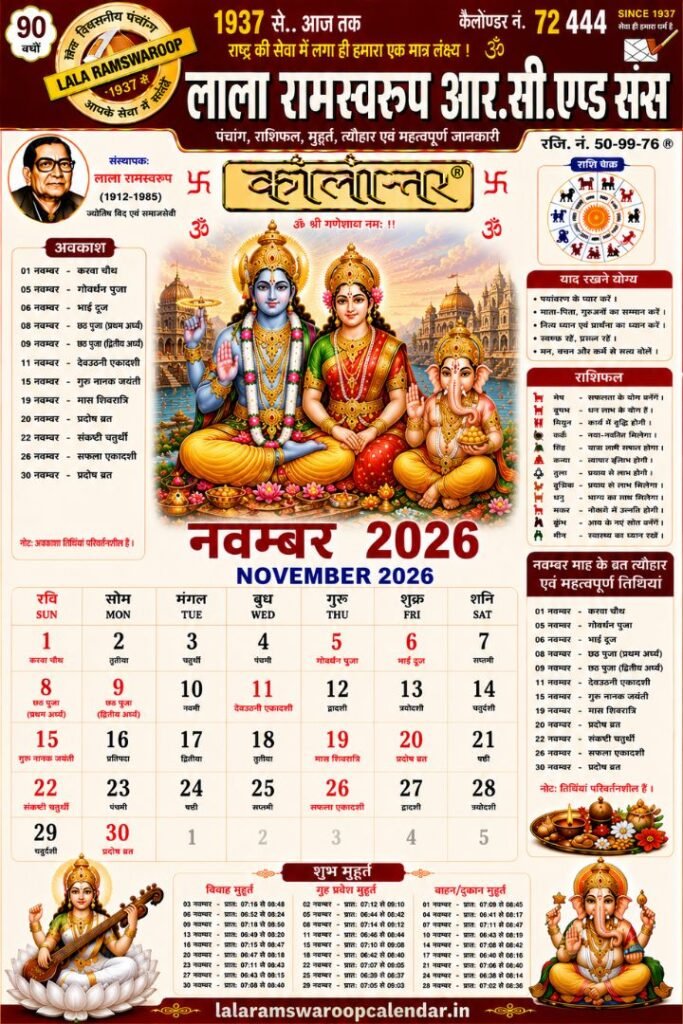
If one month decides how the rest of the year feels, it’s November. As October’s chill settles in, homes across North India begin the ritual of deep cleaning, new clothes come out, and the countdown to Diwali begins in earnest. According to the Lala Ramswaroop Calendar November 2026, this is also the month Goddess Lakshmi is welcomed into homes and Lord Vishnu wakes up after four months of yoga nidra, reopening the wedding season that paused back in July. Between Dhanteras, Diwali, Chhath Puja, and Tulsi Vivah, November carries more major festivals than almost any other month — this guide lays all of them out clearly, date by date.
The month spans the last days of Kartik and edges into Margashirsha (Agahan), and it is genuinely packed. Below is a simple, date-wise breakdown of everything worth knowing.
November 2026 Festivals at a Glance
| Date | Day | Occasion |
|---|---|---|
| November 1 | Sunday | Ahoi Ashtami |
| November 5 | Thursday | Rama Ekadashi |
| November 6 | Friday | Dhanteras |
| November 7 | Saturday | Narak Chaturdashi (Choti Diwali) |
| November 8 | Sunday | Diwali & Kartik Amavasya |
| November 9 | Monday | Govardhan Puja |
| November 11 | Wednesday | Bhai Dooj |
| November 15–16 | Sun–Mon | Chhath Puja |
| November 20–21 | Fri–Sat | Dev Uthani Ekadashi |
| November 21 | Saturday | Tulsi Vivah |
| November 24 | Tuesday | Guru Nanak Jayanti, Dev Diwali & Kartik Purnima |
Ahoi Ashtami, November 1: A Mother’s Fast for Her Children
Ahoi Ashtami falls on Kartik Krishna Ashtami and is observed mainly by mothers, who keep a strict nirjala (waterless) fast through the day for the long life and wellbeing of their children. The fast is broken in the evening after sighting the stars, following prayers to Ahoi Mata.
Rama Ekadashi, November 5
This Ekadashi falls in Kartik Krishna Paksha and is considered especially powerful in the run-up to Diwali — many devotees believe that observing it sincerely brings Goddess Lakshmi’s blessings during the Lakshmi Puja just three days later. As with all Ekadashis, rice and grains are avoided, and the fast is broken the next morning.
Dhanteras, November 6: Diwali Begins
Dhanteras opens the five-day Diwali festival and is dedicated to Lord Dhanvantari, the god of Ayurveda, along with Goddess Lakshmi and Lord Kuber. Buying gold, silver, or new utensils on this day is considered highly auspicious, believed to invite lasting prosperity into the home. Many families also begin their Diwali cleaning and decorating from this date.
Narak Chaturdashi (Choti Diwali), November 7
Also called Roop Chaudas, this day marks Lord Krishna’s victory over the demon Narakasura. A small oil lamp is traditionally lit and offered in the name of Yamraj in the evening, a ritual believed to ward off an untimely death, and it is common for people to take an early, thorough bath before sunrise.
Diwali, November 8: The Biggest Festival of the Year
Diwali falls on Kartik Amavasya and is, without question, the most awaited festival on the entire Lala Ramswaroop Calendar November 2026. It marks Lord Ram’s return to Ayodhya after fourteen years of exile, and the evening is centred on Lakshmi Puja — the grand worship of Goddess Lakshmi and Lord Ganesh, performed once the sun sets and Pradosh Kaal begins. Homes are lit with rows of diyas, rangoli is drawn at doorsteps, and firecrackers light up the sky. Since Diwali falls on Amavasya this year, the same night is also considered one of the most spiritually potent for those who practise deeper forms of worship and meditation.
Govardhan Puja, November 9
The day after Diwali, Govardhan Puja commemorates the time Lord Krishna lifted the Govardhan hill on his little finger to shelter the people of Vrindavan from torrential rain sent by Indra. Homes prepare an elaborate spread of vegetarian dishes, known as Annakut (“mountain of food”), offered first to the deity and then shared among family and neighbours.
Bhai Dooj, November 11
Bhai Dooj closes out the main Diwali festivities and celebrates the bond between brothers and sisters, similar in spirit to Raksha Bandhan. It is worth noting that Bhai Dooj is calculated a little differently from most festivals — instead of the sunrise-based Udaya Tithi rule, it follows the Tithi that is active in the afternoon (Aparahna Kaal). That is why it lands on November 11 this year rather than November 10, even though the two dates are close together. Sisters apply tilak on their brothers’ foreheads and pray for their long life, and brothers reciprocate with gifts.
Chhath Puja, November 15–16: Devotion to the Sun God
Chhath Puja is one of the year’s most demanding and deeply devotional festivals, especially significant in Bihar, Jharkhand, and eastern Uttar Pradesh. The main evening, Sandhya Arghya, falls on November 15, when devotees stand in a river or pond at sunset and offer prayers directly to the setting sun. The fast continues overnight without food or water and concludes the next morning, November 16, with Usha Arghya — an offering made to the rising sun. The entire observance runs across four days, beginning with Nahay Khay and Kharna earlier in the week.
Dev Uthani Ekadashi & Tulsi Vivah, November 20–21: Chaturmas Ends
This is arguably the most significant turning point of the month for anyone planning a wedding. Dev Uthani Ekadashi (also called Prabodhini Ekadashi) begins on November 20, marking the moment Lord Vishnu is believed to wake from the four months of yoga nidra that began back on Devshayani Ekadashi in July. The Vrat and the accompanying Tulsi Vivah — the ceremonial marriage of Tulsi Mata to Shaligram Ji — are performed the next day, November 21. With Lord Vishnu’s active blessing restored, this date unofficially opens the Hindu wedding season for the rest of the year.
Guru Nanak Jayanti, Dev Diwali & Kartik Purnima, November 24
Three observances converge on this single date. Kartik Purnima, the final and most sacred bathing day of the Kartik month, sees lakhs of devotees take a holy dip and offer deepdaan (floating lamps) at river ghats. The same night, Varanasi hosts Dev Diwali, when the ghats along the Ganga are lit with thousands of lamps in what is widely considered one of the most visually stunning religious sights in the country. It is also Guru Nanak Jayanti, the birth anniversary of Guru Nanak Dev Ji, the first Sikh Guru, marked with Prabhat Pheris, kirtan, and langar at Gurdwaras nationwide.
Vivah Muhurat in November 2026
November is the month wedding-hungry families have been waiting for. Following the four-month Chaturmas pause that began in July, the Lala Ramswaroop Calendar November 2026 marks Dev Uthani Ekadashi on November 20–21 as the official reopening of the marriage season.
From November 21 onward, the last ten days of the month carry several strong, back-to-back wedding dates, supported by Guru (Jupiter) and Shukra (Venus) being favourably placed after their earlier weak phases. This stretch — roughly November 21 to November 30 — is expected to be one of the busiest wedding windows of the entire year, so families planning a ceremony should speak to their pandit early to lock in a preferred date before the good slots fill up.
Frequently Asked Questions
Q.1 When is Diwali in November 2026?
Diwali falls on Sunday, November 8, 2026, observed on Kartik Amavasya with Lakshmi Puja after sunset.
Q.2 When is Chhath Puja in 2026?
The main evening Arghya of Chhath Puja falls on Sunday, November 15, 2026, with the closing morning Arghya on Monday, November 16.
Q.3 Why does Bhai Dooj fall on November 11 and not November 10?
Bhai Dooj follows the Aparahna (afternoon) Tithi rule rather than the usual sunrise-based rule, and this year the relevant Tithi falls in the afternoon of November 11.
Q.4 How many Ekadashi fasts fall in November 2026?
Two — Rama Ekadashi on November 5 and Dev Uthani Ekadashi on November 20–21.
Q.5 When does the wedding season reopen after Diwali?
Weddings resume from Dev Uthani Ekadashi, observed on November 20–21, 2026, with Tulsi Vivah performed on November 21.