Every January, lakhs of homes across North India reach for one calendar before planning anything important — a wedding date, a Griha Pravesh, a fast, or simply the date of the next Ekadashi. That calendar is the Lala Ramswaroop Panchang. This guide lays out the complete Lala Ramswaroop Calendar January 2026, with every major Vrat, Tyohar (festival), and auspicious Muhurat explained in one place, so you don’t have to flip through pages to find what you need.
January 2026 is an unusually eventful month on the Hindu calendar. It carries the shift from Paush month to Magh month, and inside that shift sit some of the year’s most-observed occasions — Lohri, Makar Sankranti, Mauni Amavasya, and Basant Panchami. Below is a clear, date-wise look at all of them.
Major Festivals in the Lala Ramswaroop Calendar — January 2026
| Date | Day | Festival | What It Marks |
|---|---|---|---|
| Jan 1, 2026 | Thursday | New Year’s Day | Beginning of the Gregorian calendar year |
| Jan 13, 2026 | Tuesday | Lohri | Punjab’s bonfire harvest festival |
| Jan 14, 2026 | Wednesday | Makar Sankranti | Sun’s entry into Capricorn; start of Uttarayan |
| Jan 23, 2026 | Friday | Basant Panchami (Saraswati Puja) | Worship of Goddess Saraswati, deity of knowledge |
| Jan 26, 2026 | Monday | Republic Day | India’s Constitution Day |
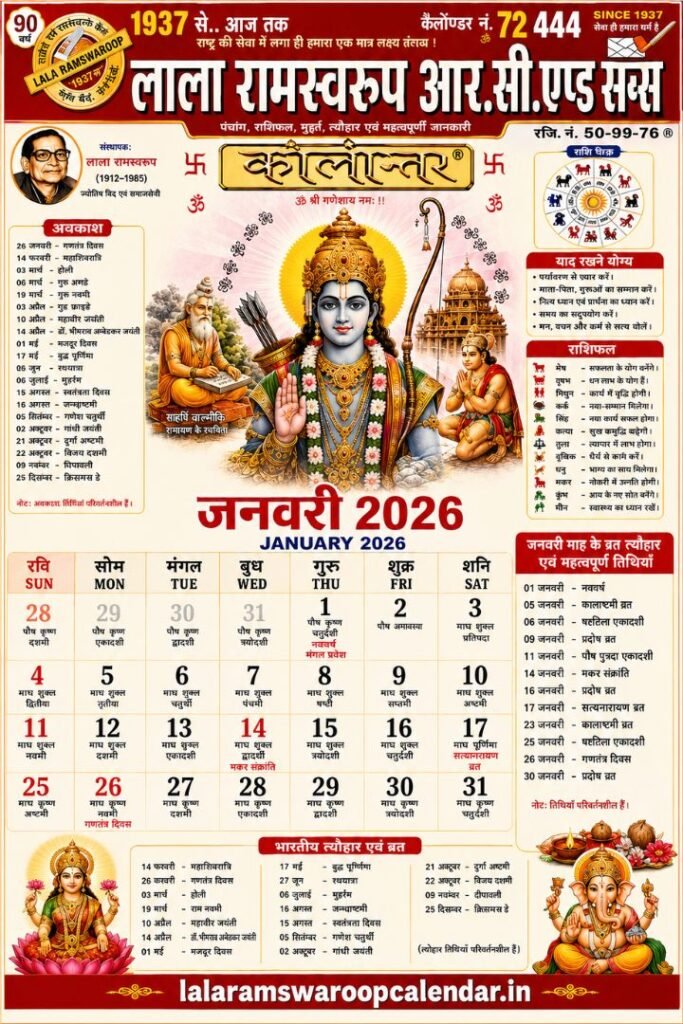
Vrat and Tithi Dates — January 2026
| Date | Day | Vrat / Tithi | Meaning |
|---|---|---|---|
| Jan 3, 2026 | Saturday | Paush Purnima | Full moon of Paush month; ideal for Satyanarayan Katha and river baths |
| Jan 7, 2026 | Wednesday | Sankashti Chaturthi | Monthly fast for Lord Ganesha |
| Jan 14, 2026 | Wednesday | Shattila Ekadashi | Ekadashi observed with six uses of til (sesame) |
| Jan 16, 2026 | Friday | Krishna Paksha Pradosh Vrat | Evening fast for Lord Shiva |
| Jan 18, 2026 | Sunday | Mauni Amavasya (Magh Amavasya) | Silent new moon; Snan-Daan and ancestor worship |
| Jan 29, 2026 | Thursday | Jaya Ekadashi | Ekadashi linked to freedom from past sins |
| Jan 30, 2026 | Friday | Shukla Paksha Pradosh Vrat | Evening Shiva fast for family wellbeing |
A point worth noting: Shattila Ekadashi and Makar Sankranti fall on the same date this year, January 14. Since Ekadashi rules discourage eating rice and grains, many families complete their Sankranti khichdi daan (charity) earlier in the day, or push certain rituals to the Dwadashi morning that follows.
Lohri and Makar Sankranti: The Harvest Fortnight
Lohri, on January 13, belongs mainly to Punjab, Haryana, and neighbouring states, tied closely to the Rabi harvest. Families light a bonfire in the evening, offer til (sesame), popcorn, peanuts, and gajak into the flames, and sing folk songs around it. A family’s first Lohri after a wedding or the birth of a child is usually celebrated with extra warmth, since it’s treated as the community welcoming the newest member.
Makar Sankranti follows the very next day, January 14, when the sun moves into Capricorn (Makar Rashi) and Uttarayan begins — six months during which the sun is considered to travel northward. Unlike most Hindu festivals, which follow the lunar calendar and shift every year, Sankranti is a solar event, so it lands on almost the same Gregorian date annually. Holy dips, khichdi daan, and til-gud sweets mark the day, and it is also considered the point after which the “inauspicious” period for major ceremonies traditionally lifts.
Mauni Amavasya: A Day Built Around Silence
Mauni Amavasya, on January 18, is the new moon of the Magh month and one of the year’s most spiritually significant Amavasyas. “Maun” means silence, and many devotees observe a Maun Vrat — avoiding speech for part or all of the day — alongside an early morning holy bath and Tarpan (offerings to ancestors). It’s traditionally linked to the Magh Mela and Kumbh-related river bathing along the Ganga, and is regarded as one of the more powerful days in the year for inward reflection rather than outward celebration.
Basant Panchami: Welcoming Spring with Saraswati Puja
Basant Panchami, on January 23, opens the door to spring and is dedicated to Goddess Saraswati, worshipped for wisdom, learning, music, and the arts. Schools, colleges, and music schools across North India typically hold Saraswati Puja ceremonies on this day, and yellow — echoing the mustard fields in bloom at this time of year — is the traditional colour worn.
On this day, students in particular pray to Goddess Saraswati for wisdom and success in their studies, and it’s considered a favourable date for starting anything related to learning or the arts.
One Festival, Many Regional Names
A feature unique to the Indian festival calendar is how a single astronomical event carries different names in different states. Makar Sankranti on January 14 is Pongal in Tamil Nadu, Uttarayan in Gujarat (known for kite-flying), Magh Bihu in Assam, and Khichdi in parts of Uttar Pradesh and Bihar. The rituals differ from state to state, but the underlying reason — the sun’s shift into Capricorn and the start of the harvest season — stays the same everywhere.
Vivah Muhurat in January 2026
Once Uttarayan begins on Makar Sankranti (January 14), the wedding season, which pauses in the preceding weeks, generally resumes. Following Sankranti, the Lala Ramswaroop Calendar typically marks several favourable dates through the rest of January, supported by:
- A cluster of favourable Yogas in the last week of the month
- A supportive placement of Guru (Jupiter) and Shukra (Venus)
- Suitable Nakshatra combinations for weddings
Conclusion
January 2026 opens the year on a genuinely full note — from the warmth of Lohri and Makar Sankranti, into the quiet reflection of Mauni Amavasya, and closing with the creative energy of Basant Panchami. With two Ekadashi fasts, a Purnima, an Amavasya, and the wedding season reopening after Uttarayan, this Lala Ramswaroop Calendar January 2026 gives North Indian households a complete, date-wise reference to plan the month around.
Frequently Asked Questions
Q.1 When is Makar Sankranti in January 2026?
Makar Sankranti falls on Wednesday, January 14, 2026, marking the sun’s entry into Capricorn and the start of Uttarayan.
Q.2 When is Lohri celebrated in 2026?
Lohri falls on Tuesday, January 13, 2026, the evening before Makar Sankranti.
Q.3 Is Republic Day part of the Panchang calendar?
Republic Day (January 26) is a national observance rather than a religious Tithi, but it’s still included in the Lala Ramswaroop Calendar as a major date of the month.
Q.4 When is Mauni Amavasya in 2026?
Mauni Amavasya falls on Sunday, January 18, 2026.