This guide covers the Lala Ramswaroop Calendar February 2026 in plain, simple language: every major Vrat, festival, and wedding Muhurat that falls in the month, along with what each one means and how it is usually observed.
February 2026 sits at the meeting point of Magh and Phalgun months. It opens with the last big bathing day of Magh, moves through Shivratri, and closes with the start of Holashtak, the eight-day pause on new ceremonies that comes right before Holi. Below is a clear, date-wise breakdown of the month.
February 2026 Festivals at a Glance
| Date | Day | Occasion |
|---|---|---|
| February 1 | Sunday | Magha Purnima & Guru Ravidas Jayanti |
| February 5 | Thursday | Sankashti Chaturthi |
| February 9 | Monday | Janaki Jayanti (Sita Ashtami) |
| February 13 | Friday | Vijaya Ekadashi |
| February 14 | Saturday | Shani Pradosh Vrat (Krishna Paksha) |
| February 15 | Sunday | Maha Shivaratri |
| February 17 | Tuesday | Phalguna Amavasya (Bhaumvati Amavasya) |
| February 19 | Thursday | Chhatrapati Shivaji Maharaj Jayanti & Phulera Dooj |
| February 24 | Tuesday | Holashtak Begins |
| February 27 | Friday | Amalaki Ekadashi (Rangbhari Ekadashi) |
Bookmark this table — it is the quickest way to check the whole month without reading line by line.
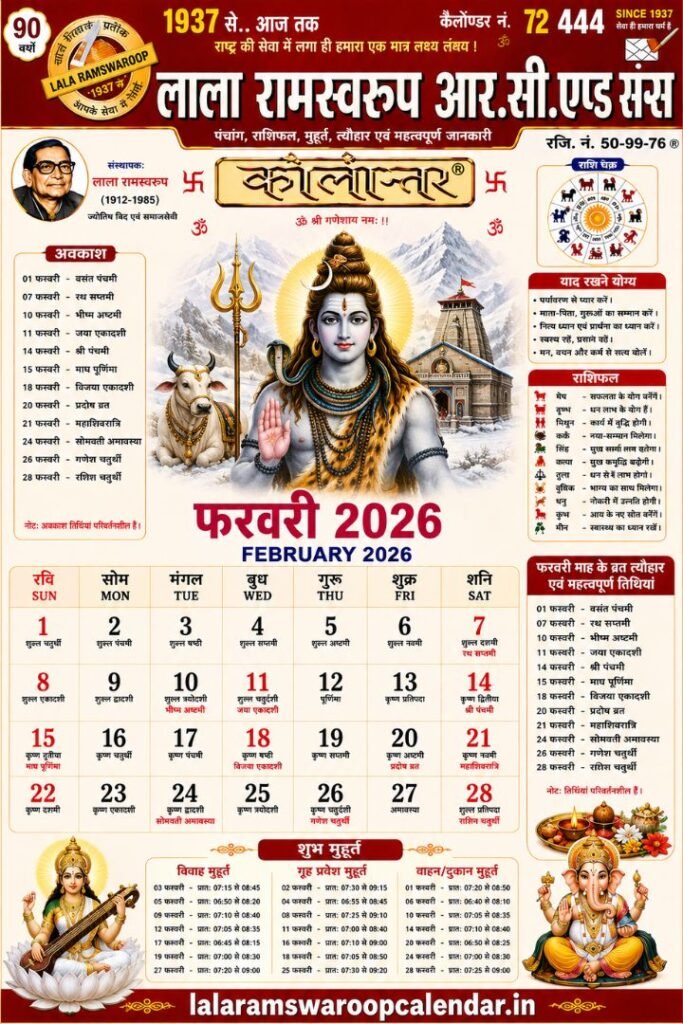
Magha Purnima, February 1: The Last Bath of Magh Month
Magha Purnima closes out the sacred month of Magh, during which many devotees observe Kalpavas — staying near a holy river, eating simple food, and living a disciplined life. On this full moon day, thousands take a dip in the Ganga, especially at Prayagraj, believing it washes away the merit-earning cycle of the whole month into something lasting. The same date also marks Guru Ravidas Jayanti, the birth anniversary of the saint-poet Sant Ravidas, observed with prayers and community gatherings, particularly in Punjab and Uttar Pradesh.
Sankashti Chaturthi, February 5
This is the monthly fourth-day fast dedicated to Lord Ganesha, observed to clear obstacles before they turn into bigger problems. Devotees typically fast through the day and break it only after sighting the moon in the evening.
Janaki Jayanti, February 9: Remembering Mata Sita
Janaki Jayanti, also called Sita Ashtami, marks the appearance day of Mata Sita. It falls on the eighth day of Krishna Paksha in Magh month and is observed mainly by devotees of Lord Ram and Mata Sita, with recitations of the Ramayana and prayers for a happy married life.
Vijaya Ekadashi, February 13
The first Ekadashi of the month, Vijaya Ekadashi, is associated with success in difficult tasks and protection during travel or important undertakings. As with all Ekadashis, rice and certain grains are avoided during the fast, and it is broken the next morning after sunrise.
Shani Pradosh Vrat, February 14
Pradosh Vrat this month falls on a Saturday, which makes it Shani Pradosh — considered especially significant, since it combines the evening worship of Lord Shiva with the day ruled by Shani (Saturn). It is best observed with prayers during Pradosh Kaal, roughly 90 minutes on either side of sunset.
Maha Shivaratri, February 15: The Biggest Festival of the Month
Maha Shivaratri is, without question, the highlight of the Lala Ramswaroop Calendar February 2026. It falls on the Krishna Paksha Chaturdashi of Phalgun month and marks the night Lord Shiva and Goddess Parvati are believed to have married. Devotees keep a strict fast, visit Shiv temples, offer Bel Patra and milk on the Shivling, and stay awake through the night in Jagran, worshipping across all four Prahars (phases) of the night. The fast is broken the next morning, after the Chaturdashi Tithi ends and the required rituals are complete. Temples like Kashi Vishwanath, Mahakaleshwar, and Somnath see some of the largest crowds of the entire year on this night.
Phalguna Amavasya, February 17: A Day for Ancestors
Since this Amavasya falls on a Tuesday, it is known as Bhaumvati Amavasya, a date considered particularly powerful for Pitru Shanti (peace for ancestors), and for remedies related to Kaal Sarp Dosh and Mangal Dosh. Many families perform Tarpan and Shraddha rituals on this day, along with charity in the name of their ancestors.
Chhatrapati Shivaji Maharaj Jayanti and Phulera Dooj, February 19
Two very different observances share the same date this year. Chhatrapati Shivaji Maharaj Jayanti, the birth anniversary of the Maratha warrior-king, is marked across Maharashtra and in many parts of the country with processions, cultural programmes, and tributes at forts associated with his life.
The same day, February 19, is also Phulera Dooj — the Shukla Paksha Dwitiya of Phalgun month, and one of the most joyful dates on the North Indian calendar. In Mathura and Vrindavan, this day is treated as the symbolic start of Holi, with temples showering Radha-Krishna idols in flowers instead of colour. Phulera Dooj is widely treated as an Abhijit or “self-auspicious” date — meaning couples whose Kundali does not throw up a clear wedding Muhurat elsewhere in the year often choose this date without needing a separate astrological reading. It remains one of the busiest wedding dates of the North Indian season.
Holashtak Begins, February 24: The Eight-Day Pause Before Holi
From Phalgun Shukla Ashtami onward, an eight-day period called Holashtak begins, running right up to Holika Dahan. Traditionally, no major auspicious work — weddings, Griha Pravesh, Mundan (a child’s first haircut), or launching a new venture — is started during this window. The belief is rooted in old stories about this period being astrologically turbulent. If you are planning a ceremony in late February, it is worth locking in the date before Holashtak starts on February 24, and confirming the exact local timing with a pandit.
Amalaki Ekadashi, February 27: Blessings Under the Amla Tree
The second Ekadashi of the month, Amalaki Ekadashi, is unique because worship is offered not only to Lord Vishnu but also to the Amla (Indian gooseberry) tree, which devotees circle in prayer. In Kashi (Varanasi), this date is celebrated on a grand scale as Rangbhari Ekadashi, when it is believed Lord Shiva brought Goddess Parvati to the city for the first time — devotees mark the day by playing with Gulal (colour) at Kashi Vishwanath temple, effectively kicking off the city’s own Holi celebrations.
Vivah Muhurat in February 2026
Weddings are in full swing through this month, since the weather is at its most pleasant and Uttarayan is already underway. Based on general Panchang conventions, the first three weeks of February — right up to Holashtak on the 24th — carry several favourable wedding dates, with February 19 (Phulera Dooj) standing out as an Abhijit Muhurat that does not require individual date-checking.
Reading the Panchang Beyond the Festival List
A Panchang is useful for more than spotting festivals — it also guides day-to-day decisions like starting a business, signing a property deal, or beginning a journey. Each date in the Lala Ramswaroop Panchang carries its own Tithi, Nakshatra, Yoga, and Choghadiya (blocks of favourable and unfavourable time through the day). If you are using a printed copy at home, look for the Rahu Kaal and Choghadiya columns specific to your own city, since these are usually printed separately from the main festival table and change from place to place.
Frequently Asked Questions
When is Maha Shivaratri in February 2026?
Maha Shivaratri falls on Sunday, February 15, 2026, marking the night Lord Shiva and Goddess Parvati are believed to have married.
When is Phulera Dooj in 2026?
Phulera Dooj falls on Thursday, February 19, 2026, the same date as Chhatrapati Shivaji Maharaj Jayanti this year.
When does Holashtak start before Holi in 2026?
Holashtak begins on Tuesday, February 24, 2026, and runs for eight days up to Holika Dahan, during which major ceremonies are traditionally avoided.
How many Ekadashi fasts fall in February 2026?
Two — Vijaya Ekadashi on February 13 and Amalaki (Rangbhari) Ekadashi on February 27.
Is Phulera Dooj really a Muhurat-free wedding date?
Yes, it is widely treated as an Abhijit date, meaning couples can marry on this day without a separate Muhurat reading. Even so, checking the individual Kundali of both partners with a pandit is still recommended.
Can I plan a wedding after February 24?
It is best avoided. Once Holashtak begins on February 24, auspicious ceremonies including weddings are traditionally paused until after Holi, so dates in the back half of the month should be planned before this window starts.